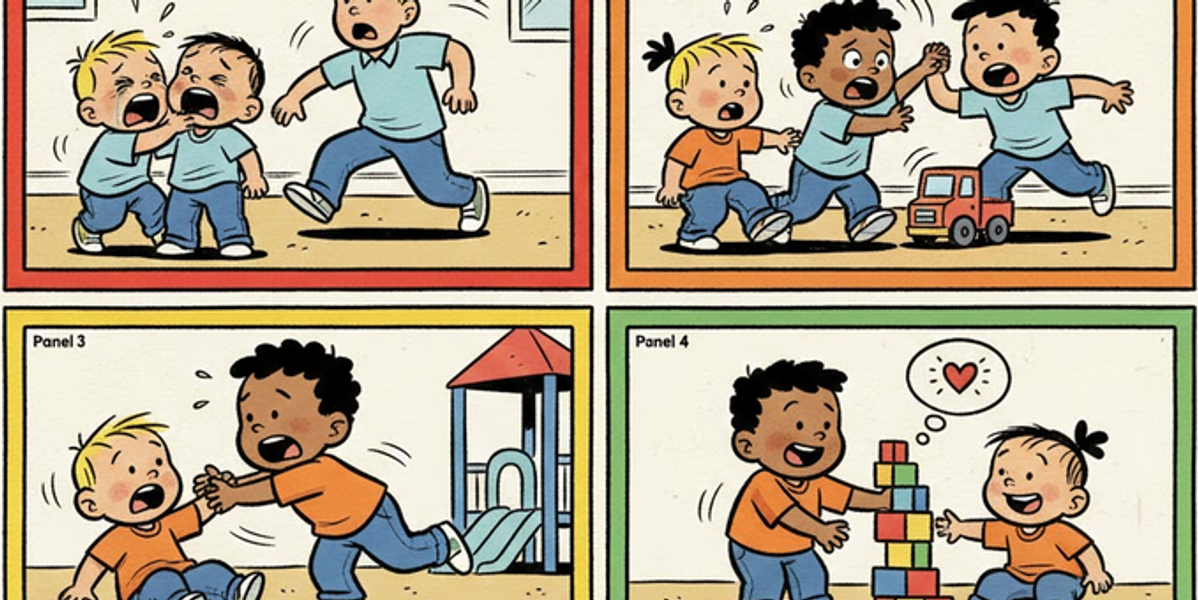
Biting, Hitting, Pushing? Stop Aggression Fast
Your child just bit another kid at the playground, hit their sibling over a toy, or pushed a friend during a playdate. You're embarrassed, worried you're raising a bully, and nothing you've tried is working. This is one of the hardest phases of parenting—but there's a clear system that stops most aggression within two weeks when applied consistently.
Try This Right Now
Before we dive into the full strategy, here's something you can try immediately:
- ✓Get down to their eye level and say firmly: "I won't let you hurt people. Hitting hurts."
- ✓Move them away from the situation calmly (don't yank or grab roughly)
- ✓Stay close for 2-3 minutes without lecturing—just be present
- ✓Offer a safe way to release big feelings: "You can stomp your feet or squeeze this pillow"
The 5-Step System to Stop Aggression
1. Intervene Immediately Every Single Time
Consistency is everything. Missing even one incident teaches them aggression sometimes works.
WHAT TO DO:
- Stop what you're doing the instant you see aggression starting
- Get physically between your child and the other person
- Use your body to block, not your words to convince
- Move your child away from the situation immediately
- Don't wait to see if they'll "work it out"—they won't at this age
WHY THIS WORKS:
Young children can't learn from delayed consequences. Their brain needs immediate cause and effect: "I hit, the fun stops right now." When you intervene every time without exception, their brain learns the pattern. Inconsistency—sometimes you stop it, sometimes you don't—actually makes aggression worse because they keep testing to see when it will work.
"I won't let you hit. Hitting hurts people."
Say this firmly and calmly while physically blocking. One sentence, then action.
2. Name the Feeling, Not the Behavior
Aggression is almost always about overwhelming feelings they can't express with words yet.
WHAT TO DO:
- After you've stopped the aggression, get down to their level
- Name what you think they're feeling: "You're really mad" or "You wanted that toy"
- Acknowledge the feeling is okay: "It's okay to feel angry"
- Make the boundary clear: "It's not okay to hit"
- Keep it short—they're flooded and can't process long explanations
WHY THIS WORKS:
When you name their emotion, you're teaching them emotional literacy. Their brain is experiencing a storm of feelings but they don't have the language yet. You're giving them words for what's happening inside. This gradually builds the skill they need to use words instead of fists. Shaming them for the feeling ("Don't be angry!") makes it worse. Accepting the feeling while blocking the behavior teaches them both are valid—feelings yes, violence no.
"You're so frustrated! You wanted the truck and he wouldn't give it to you. I get it. But hands are not for hitting. Use your words: 'My turn please.'"
Say this calmly and simply. Don't lecture or ask why they did it.
3. Teach the Replacement Behavior
You can't just say "don't hit." You have to teach what to do instead.
WHAT TO DO:
- Practice gentle touch when everyone is calm: "Show me gentle hands on teddy"
- Teach specific words to use: "Say 'stop' with a loud voice" or "Say 'my turn'"
- Give them physical alternatives for big feelings: stomp feet, squeeze play-doh, push a wall, hit a pillow
- Role-play with stuffed animals: "Teddy wants Bear's toy. What can Teddy say?"
- Praise heavily when they use the replacement: "You used your words! You said 'stop!' That's how we do it!"
WHAT TO SAY DURING PRACTICE:
"When you're mad, you can stomp your feet like this (demonstrate). Or you can say 'I'm MAD!' really loud. But you can't hit people. Let's practice."
Make it playful and practice often, not just after incidents.
WHAT TO SAY WHEN THEY USE THE ALTERNATIVE:
"You were mad at your brother but you used your words instead of hitting! That's so hard and you did it!"
Be genuinely excited. This is huge progress.
WHY THIS WORKS:
Their impulse control is nearly zero. They need automatic replacement behaviors that are just as satisfying as hitting but socially acceptable. Stomping or yelling "I'M MAD" releases the same energy as hitting but doesn't hurt anyone. The more you practice when calm, the more likely they'll access these tools when upset. It's building new neural pathways through repetition.
4. Remove Them Without Anger
Consequences work, but only if they're calm and immediate—not punishment-based.
WHAT TO DO:
- The instant aggression happens, calmly say: "You hit. We're taking a break."
- Move them to a boring spot near you (not a dramatic time-out in another room)
- Stay close for 2-3 minutes—this is connection time, not isolation
- Don't lecture, argue, or discuss during the break
- After 2-3 minutes: "You're ready. Let's try again."
"You bit. We're sitting here together for a minute."
No anger, no lectures. Just calm, immediate consequence.
WHAT NOT TO SAY:
"Why did you do that? What's wrong with you? You're being so mean!" (This is shaming, not teaching.)
WHY THIS WORKS:
Young children need co-regulation, not isolation. When you sit near them calmly, you're helping their nervous system calm down. Yelling or sending them away alone activates their stress response and they learn nothing except that you're scary when mad. The break is brief because their sense of time is terrible—2 minutes feels like forever. The key is consistency and calmness, not duration.
5. Prevent When Possible
Aggression spikes when kids are tired, hungry, overstimulated, or bored.
WHAT TO DO:
- Watch for triggers: Is it always at certain times or places?
- Keep playdates short (30-45 minutes max for toddlers)
- Have snacks ready—hunger drives a lot of aggression
- Step in before escalation: if toy-grabbing is starting, redirect immediately
- Leave before meltdowns: if you see signs of overwhelm, it's time to go
- Avoid situations you know they can't handle yet
WHAT TO SAY WHEN YOU SEE TROUBLE BREWING:
"You both want that truck. I'm going to help. Let's set the timer for turns."
Prevent the aggression instead of waiting for it to happen.
WHY THIS WORKS:
Prevention is easier than intervention. Their prefrontal cortex—the part that controls impulses—is barely developed. When they're tired or hungry, it goes completely offline. You're not making excuses for bad behavior; you're being realistic about their developmental limits. Most parents see aggression drop by 50% just by avoiding high-risk situations and times.
What This Looks Like in Real Life
Rachel's 2.5-year-old was biting other kids at daycare multiple times a week. After implementing immediate intervention and teaching him to stomp his feet when frustrated, biting dropped to once a week within 10 days. By week three, he was going full weeks without incidents. He's three now and still has rough moments when overtired, but the aggressive phase is mostly behind them. It took consistency, not perfection—and patience with the process.
When Things Don't Go as Planned
Why This Works (The Nerdy Stuff)
The amygdala develops before the prefrontal cortex.
Your child's emotional center (amygdala) is fully online and firing, creating huge feelings. But their impulse control center (prefrontal cortex) barely exists yet—it won't be fully developed until their mid-twenties. This means they feel everything intensely but have almost no ability to control their reactions. They're not choosing to be aggressive; their brain literally can't stop the impulse yet.
Mirror neurons learn through watching and repetition.
When you model calmness during their aggression, their brain's mirror neurons are learning: "This is how we handle big feelings." When you yell or hit them for hitting, their mirror neurons learn: "When angry, we use our bodies." You are literally programming their future responses through your reactions now. Stay calm not because you're perfect, but because their brain is watching.
Aggression is a communication problem, not a behavior problem.
Research shows most toddler aggression happens when they can't express needs with words. A child who can say "I'm angry" is far less likely to hit than one who can't. As their language explodes between ages 2-4, aggression typically drops. Your job is to survive the gap and teach them words for feelings.
Shame increases aggression, connection decreases it.
Brain imaging shows that shame activates the same neural pathways as physical pain. When you shame a child for aggression ("Bad boy! You're mean!"), their brain experiences pain, which triggers more aggression. When you stay connected ("You're having a hard time. I'm here."), their stress hormones drop and they can access learning.
You've Got This
Give this system two full weeks of absolute consistency before judging if it's working. Most parents see real improvement by day 10-14, but some kids—especially strong-willed or highly sensitive ones—take longer. If you're seeing even 20% reduction, you're on the right track.
You will mess up. You'll yell, you'll react in anger, you'll be inconsistent because you're exhausted. When that happens, repair: "I yelled at you. That wasn't okay. I was frustrated but I should have stayed calm." Your repair teaches them more than your perfection ever could.
This phase is brutal and isolating. Other parents are judging you, you're scared to go anywhere, and you're questioning everything. But aggression in toddlers and preschoolers is normal development, not a character flaw. You're not raising a violent person—you're teaching a tiny human with a massive feelings and a tiny brain how to be in the world. It gets better. You've got this.
Related Posts

Up All Night With a Scared Kid? 5 Steps That Actually Help
Woken up three times tonight by a scared or restless child? You're not failing — nighttime fears are brutal. Here's a realistic, step-by-step plan to help everyone sleep better, starting tonight.

Saying Everything Twice? 5 Steps to Get Kids to Listen the First Time
You've said it five times and they still haven't moved. Here's why repeating yourself isn't working — and a practical system that actually gets kids to respond the first time you ask.

Restaurant Meltdowns? 5 Steps to Actually Enjoy Eating Out
Eating out with kids doesn't have to mean survival mode. Here's a practical system that makes restaurant meals actually enjoyable — for everyone at the table.