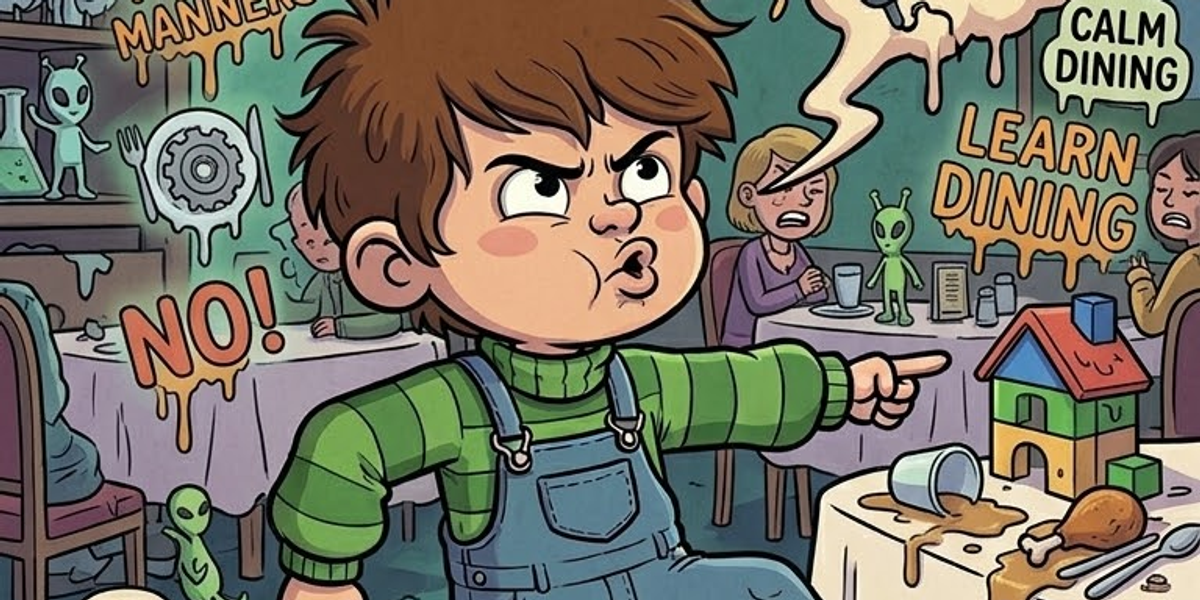
Restaurant Meltdowns? 5 Steps to Actually Enjoy Eating Out
You used to love going out to eat. Now it means sweating through the menu, apologizing to strangers, and leaving before dessert. You're not doing it wrong — restaurants are genuinely hard for kids. And there's a way to make them work.
Before Your Next Outing, Try This
Here's what to do before you even walk through the door:
- ✓Pick the right restaurant — look for noisy, casual, and family-friendly (not quiet, dim, or precious)
- ✓Eat at an off-peak time — 5:00 PM beats 7:00 PM every single time with kids
- ✓Bring one small activity your child hasn't seen in a while (a mini notepad, a new sticker sheet, one small toy)
- ✓Talk about it beforehand: *"We're going to a restaurant tonight. Here's what that looks like."* — 30 seconds of prep makes a real difference
The 5-Step System
1. Choose the Right Restaurant
The venue does half the work — or doubles your stress. Set yourself up before you arrive.
WHAT TO DO:
- Look for restaurants with high noise levels, casual atmosphere, and quick service
- Call ahead or check online: do they have a kids' menu, crayons, or high chairs?
- Choose booths when possible — they contain kids better than open tables
- Sit near an exit or in a corner, away from other diners
WHY THIS WORKS:
Environment shapes behavior. A loud pizza place forgives a loud 3-year-old. A hushed bistro does not. Match the setting to your child's actual capacity, not the capacity you wish they had.
"We're going to [restaurant name] — they have a kids' menu and it's going to be fun. You can order your own thing."
Say this on the way there, not as you're walking in.
2. Set Expectations Before You Walk In
Kids do better when they know what's coming — not because you lectured them, but because the unknown is stressful.
WHAT TO DO:
- In the car or on the way, give a quick, cheerful preview
- Name two or three specific behaviors you expect (not a long list)
- Tell them what happens after — something to look forward to
WHY THIS WORKS:
Predictability reduces anxiety. When kids know the sequence of events and what's expected, they spend less energy on resistance and more on just being there.
"At the restaurant, we stay in our seats, we use our indoor voices, and we wait for the food together. After, we can walk around the block if you want."
Keep it light. This is a heads-up, not a warning.
3. Manage the Wait Strategically
The wait for food is where most restaurant outings fall apart — and it's completely manageable with a little prep.
WHAT TO DO:
- Order your child's food first, or at the same time as drinks
- Bring a low-tech activity they haven't seen recently (rotate what you keep in your bag)
- Have something ready to do the moment you sit down — don't wait for the meltdown to start
- For younger kids: bring a small snack to tide them over while you wait
WHY THIS WORKS:
Young children have no concept of "food will arrive in 15 minutes." The wait feels endless and purposeless. Giving them something engaging bridges the gap and keeps frustration from building.
"While we wait for the food, here's your [activity]. When the food comes, we put it away."
Frame it as a sequence, not a reward or a bribe.
4. Give Them a Job at the Table
Kids sit better when they have a role — even a tiny, made-up one.
WHAT TO DO:
- Assign a simple task: hold the menus, choose a drink for themselves from two options, tell the server their order
- Let them help with small decisions: "Should we share the bread or not?"
- For older kids, let them calculate the tip or pick the dessert to split
WHY THIS WORKS:
Participation reduces the feeling of being dragged along. When kids have ownership over even one small part of the meal, their buy-in goes up and their restlessness goes down.
"Your job tonight is to tell the server what you want to drink. Can you practice what you're going to say?"
Ask this on the way in — not when the server is standing there.
5. Have an Exit Plan (and Use It Without Shame)
Knowing you can leave — and being willing to — takes the pressure off the whole meal.
WHAT TO DO:
- Before you go in, decide your threshold: what behavior means it's time to step outside?
- When it hits, take your child outside calmly — not as punishment, just as a reset
- One parent steps out; the other stays with the food
- Come back in when they're regulated. Don't extend the meal past their capacity.
WHY THIS WORKS:
Kids often melt down because they're overstimulated, not because they're being difficult. A 3-minute outdoor reset does more than any in-seat negotiation. And leaving without shame teaches them that restaurants are manageable — not places where they always fail.
"We're going to step outside for a minute. Not in trouble — just need some air. We'll come back in."
Say this calmly and move quickly. The less drama, the faster the reset.
What This Looks Like in Real Life
Marco and his wife had stopped going out entirely after their 4-year-old's last restaurant meltdown ended with a knocked-over water glass and a hasty retreat. They tried one low-stakes lunch at a casual taco place — early, booth in the corner, sticker book in hand, and a heads-up conversation in the car.
It wasn't perfect. Their son got squirmy in the last 15 minutes and they skipped dessert. But they finished their food. Nobody cried. They went back two weeks later and made it to dessert.
Now restaurants are part of their regular rotation again. They still pick casual over fancy and always bring something to do. But the dread is gone — and that's been the real win.
When Things Don't Go as Planned
Why This Works (The Nerdy Stuff)
Restaurants are genuinely one of the harder environments for young children. They combine unpredictable wait times, unfamiliar food, confined physical space, high sensory stimulation, and a social expectation of stillness — all at once. It's a lot. The fact that your child struggles there doesn't mean something is wrong with them.
Young children's brains are still building the circuitry for delayed gratification, impulse control, and emotional regulation. These skills live in the prefrontal cortex, which isn't fully online until the mid-20s. Asking a 4-year-old to sit still and wait quietly for 30 minutes is asking for something their brain isn't yet wired to deliver reliably.
What works is external scaffolding — structure, predictability, and engagement that do the regulatory work their brains can't do alone yet. The prep conversation lowers anxiety. The activity bridges the wait. The job gives them agency. The exit plan removes the pressure that makes meltdowns worse.
Over time, with repeated positive experiences, restaurants become a known, manageable thing. That's how kids learn to handle them — not through lectures, but through enough successful trips that the pattern feels familiar and safe.
You've Got This
Expect the first few outings to feel like work. They are. Most families start seeing a real shift after 3-4 attempts with the same system — not perfection, but noticeably better. Some kids take longer. That's not a reflection on your parenting.
You'll have outings that fall apart despite everything. You'll leave early, skip the thing you ordered, or walk out wishing you'd stayed home. That's just part of the process. Go again when you're ready.
You're not the family that can't go to restaurants. You're the family that's still figuring it out — and that's a completely different thing. Keep the bar low, the outings short, and the restaurant casual. It gets easier. You've got this.
Related Posts

Up All Night With a Scared Kid? 5 Steps That Actually Help
Woken up three times tonight by a scared or restless child? You're not failing — nighttime fears are brutal. Here's a realistic, step-by-step plan to help everyone sleep better, starting tonight.

Saying Everything Twice? 5 Steps to Get Kids to Listen the First Time
You've said it five times and they still haven't moved. Here's why repeating yourself isn't working — and a practical system that actually gets kids to respond the first time you ask.

Can't Finish a Sentence? 5 Steps to Stop Constant Interrupting
You can't finish a single thought without 'Mom! Mom! Mom!' cutting you off. You're not alone — and there's a realistic system that teaches kids to wait without a meltdown.