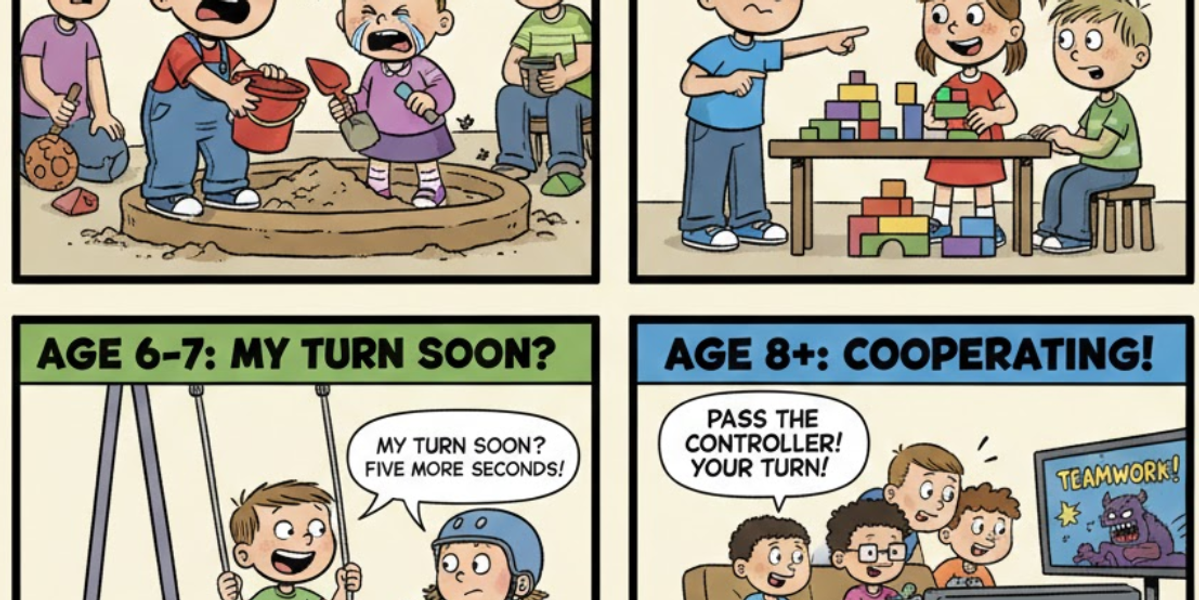
Sharing Wars? What's Actually Normal at Each Age
Your toddler snatches toys from other kids, refuses to take turns, and melts down when asked to share. You're embarrassed at playdates, worried you're raising a selfish child, and exhausted from constantly refereeing. Here's the truth: most of what you're seeing is completely normal—and forcing young kids to share before they're ready actually backfires.
Try This at the Next Playdate
Before we dive into the full strategy, here's something you can try right now:
- ✓Stop saying "share" and start saying "his turn, then your turn"
- ✓Set a visual timer for 3-5 minute turns with coveted toys
- ✓Let your child have 2-3 "special toys" that don't need to be shared
- ✓Narrate what you see instead of forcing: "You both want the truck. That's hard."
What's Normal at Each Age
1. Under Age 2: Sharing Isn't Possible Yet
Toddlers under two don't have the brain development to share. Expecting it sets everyone up for failure.
WHAT TO DO:
- Don't force sharing—it teaches nothing and creates resentment
- Have duplicate toys available for playdates (two balls, two trucks)
- Use "trading" instead: "You can have the ball when you give him the car"
- Protect their space: "You're playing with that. I won't let him take it."
- Model turn-taking without pressure: "My turn to push the button. Now your turn!"
WHY THIS WORKS:
Before age two, toddlers don't understand that other people have thoughts and feelings separate from theirs. This is called "theory of mind" and it literally hasn't developed yet. They're not being selfish—they're being developmentally appropriate. Forcing sharing at this age teaches them that their needs don't matter and that bigger people take things from them.
"You're playing with that truck right now. When you're done, Sam can have a turn."
Say this matter-of-factly while blocking the other child from grabbing. You're protecting both kids.
2. Ages 2-3: Parallel Play and "Mine!"
Two and three-year-olds are in the "mine" phase. This is normal and necessary.
WHAT TO DO:
- Let them play near other kids without requiring interaction (parallel play is enough)
- Use timers for turn-taking: "You get the swing for 5 minutes, then it's Maya's turn"
- Offer choices: "You can share the blocks or play with the train. You choose."
- Remove the toy if they can't take turns: "The blocks are taking a break. You can try again later."
- Praise specific sharing when it happens: "You gave her a block! She's smiling!"
WHAT TO SAY WHEN THEY WON'T SHARE:
"I know you want to keep playing with it. The timer says it's Jake's turn now. You can have it back in 5 minutes."
Stay calm and follow through. Don't negotiate or extend time.
WHAT TO SAY WHEN THEY DO SHARE:
"You let her play with your truck! That was kind. Look at her face—she's happy."
Connect their action to the other child's emotion.
WHY THIS WORKS:
Two and three-year-olds are learning that they're separate people with their own things. The "mine" phase is actually healthy—it's them establishing boundaries and identity. Timers work because they're neutral third parties. You're not the bad guy; the timer is. Short turns (3-5 minutes) feel manageable and teach delayed gratification without overwhelming their limited self-control.
3. Ages 3-4: Beginning to Understand Turn-Taking
Three and four-year-olds can start learning real turn-taking, but it's still hard.
WHAT TO DO:
- Teach turn-taking with activities, not just toys: "You pick the book, I pick the next one"
- Use visual aids: "Whose turn is it?" chart with names and pictures
- Practice at home before expecting it with friends
- Let natural consequences teach: if they won't share, friends won't want to play
- Role-play sharing scenarios with stuffed animals
"We're taking turns. You had it for your turn. Now it's his turn. When the timer beeps, it's your turn again."
Be specific about when they get it back. Their sense of time is fuzzy.
WHAT TO SAY DURING CONFLICT:
"You both want the ball. That's a problem. What could we do? Should we set a timer or find another ball?"
Invite problem-solving instead of dictating solutions.
WHY THIS WORKS:
Three and four-year-olds are developing empathy but it's fragile and inconsistent. They can understand turn-taking in theory but their impulse control is still weak. When you involve them in solving the problem, you're building their executive function skills. They learn better from natural consequences (friend leaves because they won't share) than from lectures.
4. Ages 4-5: Sharing with Support
Four and five-year-olds can share and take turns, but still need reminders and structure.
WHAT TO DO:
- Set expectations before playdates: "Friends are coming. Which toys are okay to share? Which are special?"
- Put away special toys before friends arrive
- Coach in the moment: "I see you both want that. How can you solve this?"
- Praise effort, not just success: "You're trying to figure this out together. That's great!"
- Let them work it out unless someone's getting hurt
"Before Emma comes over, let's put away toys you don't want to share. Everything else, you'll need to take turns with."
This gives them control and sets clear boundaries.
WHAT TO SAY DURING DISPUTES:
"Looks like you both have ideas about the Legos. Can you figure out a plan together, or do you need my help?"
Offer to help but don't jump in immediately.
WHY THIS WORKS:
Four and five-year-olds have enough language and problem-solving ability to work through conflicts with coaching. When you step back and let them try first, you're building crucial social skills. They need practice negotiating, compromising, and managing disappointment. Your job shifts from referee to coach.
5. Ages 5+: Independent Sharing (Mostly)
By five or six, most kids can share and take turns without constant supervision, though conflicts still happen.
WHAT TO DO:
- Let them solve most conflicts themselves unless it escalates
- Teach specific skills: trading, asking politely, waiting patiently
- Point out when sharing feels good: "You both had fun building that together!"
- Address patterns if one child always gives in (people-pleasing) or never shares (boundary issues)
- Model sharing in your own life: "I'm sharing my cookies with you because I love you"
"I hear you both arguing about the game. I trust you can figure this out. Come get me if you need help."
Empower them to solve it, but stay available.
WHAT TO SAY IF THEY CAN'T SOLVE IT:
"It sounds like you're stuck. Let's think together. What have you each tried? What else could work?"
Guide without solving for them.
WHY THIS WORKS:
By age five, their prefrontal cortex has developed enough for basic self-regulation and empathy. They can hold multiple perspectives in mind and delay gratification for longer periods. When you trust them to solve conflicts, you build competence and confidence. They need less intervention and more opportunities to practice.
What This Looks Like in Real Life
Linda's 3-year-old grabbed toys from every child at the playground, and she was mortified. After learning that forcing sharing made it worse, she started using timers and stopped apologizing for normal toddler behavior. Within two weeks, her daughter started waiting for the timer voluntarily about half the time. At four, she now shares without prompting on good days. Bad days still happen, but Linda has tools and realistic expectations—and that's made all the difference.
When Things Don't Go as Planned
Why This Works (The Nerdy Stuff)
Theory of mind develops between ages 3-5.
This is the ability to understand that other people have thoughts, feelings, and desires different from yours. Until this develops, sharing makes no sense to a child. They literally can't comprehend why someone else would want "their" toy. Brain imaging shows the prefrontal cortex regions responsible for perspective-taking aren't fully active until around age four.
Forced sharing teaches the wrong lesson.
Research shows that toddlers forced to share before they're ready learn that adults will take their things and give them to others. This actually delays the development of genuine generosity. Kids who are allowed to finish playing before giving up a toy learn that their needs matter, which paradoxically makes them more willing to share later.
Turn-taking is easier than sharing.
Sharing implies giving something up indefinitely, which is terrifying to young children who live entirely in the present moment. Turn-taking has a clear endpoint—they get it back. This matches their developmental ability to delay gratification. Visual timers work because young children are concrete thinkers who need to see time passing.
Natural consequences are more powerful than punishment.
When a five-year-old won't share and their friend stops playing with them, they learn cause and effect. When you force a three-year-old to share and they cry, they only learn that you take their things. The brain learns best from natural outcomes, not adult intervention, once executive function develops enough around age four.
You've Got This
Give your child time to develop these skills naturally. If they're under three, stop expecting sharing and focus on turn-taking with timers. If they're three to five, provide lots of practice opportunities with coaching. You should see gradual improvement over months, not days.
You'll have moments where you force them to share because you're embarrassed or exhausted. That's okay. Repair it: "I made you give her your toy. That wasn't fair. Next time I'll use the timer." Your child learns more from your repairs than your perfection.
Sharing is a complex social skill that takes years to develop fully. You're not raising a selfish child—you're raising a human whose brain is still growing. Meet them where they are, not where you wish they were. Small steps forward are still progress. You've got this.
Related Posts

Up All Night With a Scared Kid? 5 Steps That Actually Help
Woken up three times tonight by a scared or restless child? You're not failing — nighttime fears are brutal. Here's a realistic, step-by-step plan to help everyone sleep better, starting tonight.

Saying Everything Twice? 5 Steps to Get Kids to Listen the First Time
You've said it five times and they still haven't moved. Here's why repeating yourself isn't working — and a practical system that actually gets kids to respond the first time you ask.

Restaurant Meltdowns? 5 Steps to Actually Enjoy Eating Out
Eating out with kids doesn't have to mean survival mode. Here's a practical system that makes restaurant meals actually enjoyable — for everyone at the table.